100th Anniversary of America’s Entry into World War I – and a surprising family history find!

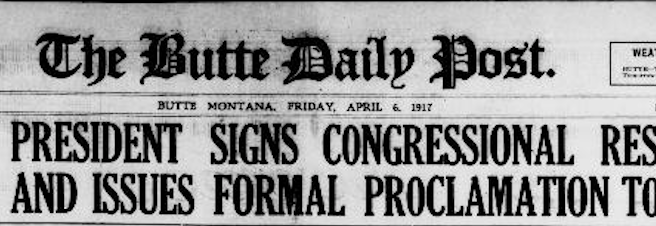
In commemoration of America’s Entry into World War I on April 6, 1917, the National Archives has launched a World War I Research Portal “with the goal of creating a central space for all National Archives resources and content related to World War I for use by researchers, students and educators, and those curious about the War.”

So that of course got me to thinking about my Montana ancestors. Continue reading

I love Google – again!!

I’ve been having fun lately using the Google Earth overlay feature to map where my ancestors lived in various townlands in Ireland during the 19th century. By referencing Griffith’s Valuation records, it’s possible to determine with a great deal of accuracy where they lived and what land they were leasing.

While doing U.S. research last weekend on my great great grandparents Lewis Blacker and Margaret Rebecca (Loury/Lower) Blacker, I wondered if it might be possible to map where they lived in 1850.

Here is the family in the census record – Lewis and Margaret living with their two daughters Elizabeth and her husband Nathan Pierce and Sarah and her husband Alonzo Ford – living in Ward 1, City of Dayton, Miami County, Ohio.

I started by searching Google for an historic map related to that location and time period but the closest I could find was this 1875 map from historicmapworks.com.

Looking again at the 1850 U.S. Census record, I was hoping to find some reference to an address, or at least a street name – but was quickly disappointed when I realized there were none. The only reference is the “dwelling house” number (column 1) and a number indicating the order in which each family was visited (column 2).

Never one to give up easily, however, I wondered if maybe, just maybe, there might be some other notation or reference to a landmark that might give me a clue. So I decided to go through the record, page by page.

Luckily, I didn’t have to go far. The very first listing on page 1 was for a group of people who lived in a hotel. A rather large group of people – 27, to be exact. That could be good, right? A rather large hotel possibly owned by the first person listed – a “hotel keeper” by the name of Francis Ohmer.
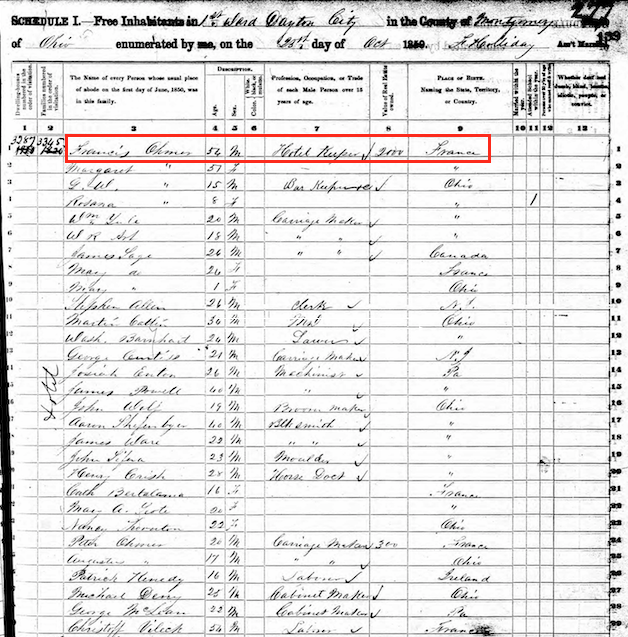
Next, I searched Google for Mr. Ohmer’s name, plus a few additional identifiers like “Ohio” and “1850” – and soon came across the American Antiquarian Society web site, with a reference to the Richard P. Morgan Indexes. Included there is a searchable database of the “Ohio Name Index, 1796-1900”, which includes “Odell’s Dayton Directory and Business Advertiser, 1850”. And Mr. Ohmer is in that database.

It appeared at first that the directory was a listing of business people so I began by searching the database for other individuals listed in the 1850 census that looked like they might have owned a business . . . a distiller, a moulder, a grocer, and a cooper. By mapping the addresses of those businessmen, I might be able to ascertain the direction in which the census taker was moving, which would ultimately help me determine where the Blackers lived.

And my idea seemed to be working. And then, quite by accident, I realized there were some “laborers” listed in the directory.

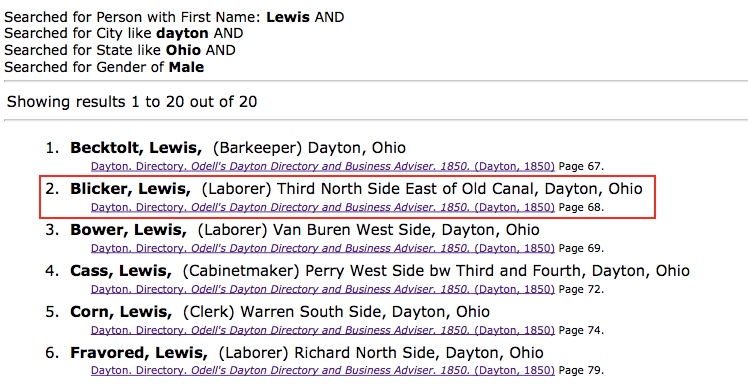
Since Lewis Blacker was listed as a “laborer” in the census, I searched his first and last name in the database but nothing came up. Remembering that “Blacker” is often misspelled, I tried searching on his first name alone – and I got lucky. There was only 20 names in the result, one for a “Lewis Blicker“. A laborer who lived at “Third North Side East of Old Canal, Dayton, Ohio”. And since “Blicker” is an alternate spelling that comes up over and over again (which will be the subject of a blog post in the near future), I believe this is my guy!
I was unable to find a digital image of the directory online but did discover several locations where I could order a reproduction, at a very reasonable price. So I placed an order – and it came in the mail yesterday. Hooray!

Here’s an image of the page where Lewis Blicker appears.
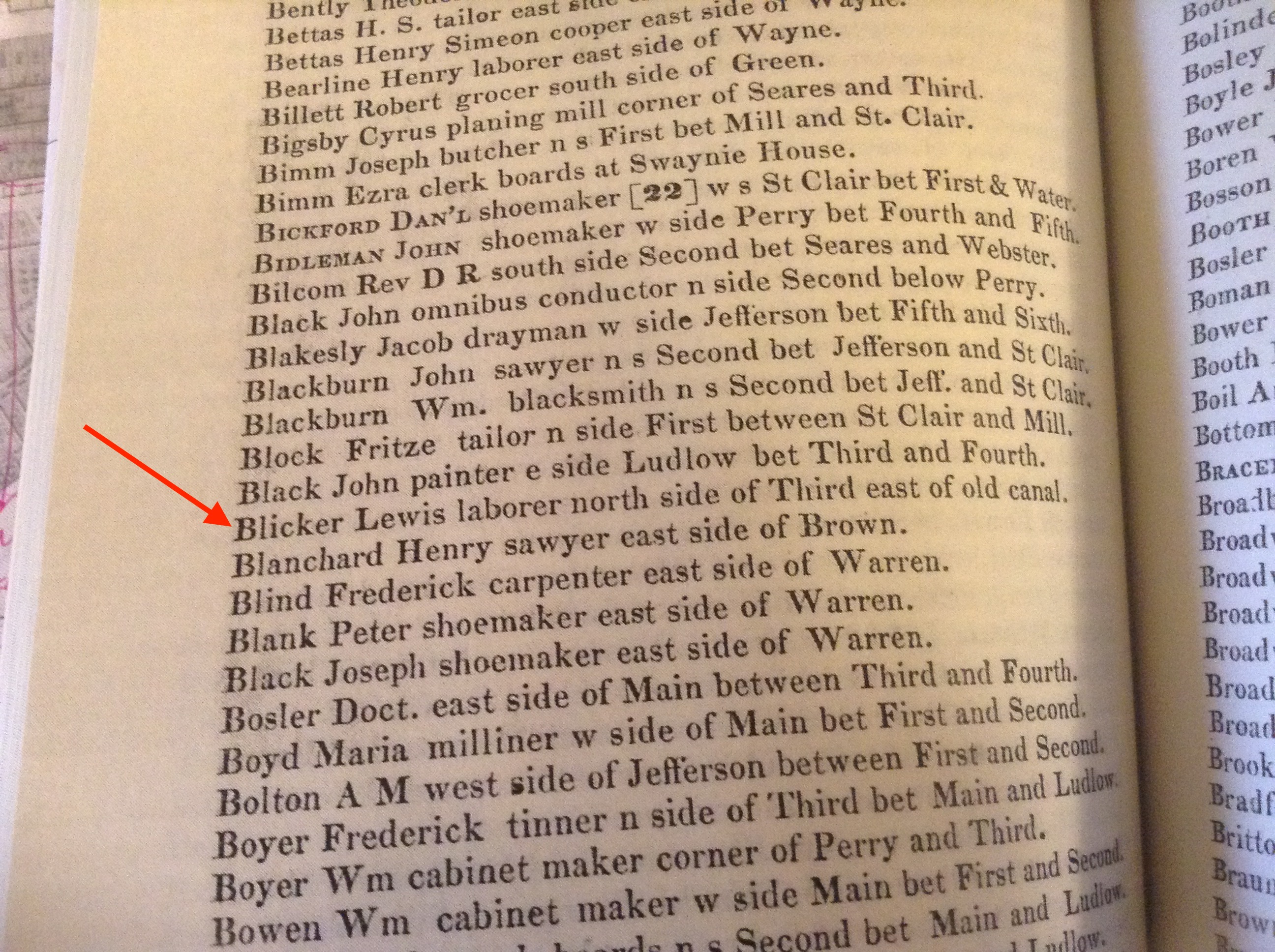
And so now I know he lived on the “north side of Third east of old canal.” Well, at least that’s where he lived according to the Dayton directory.

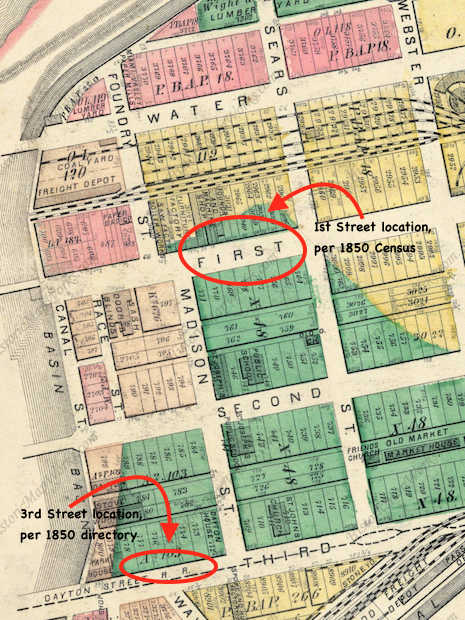
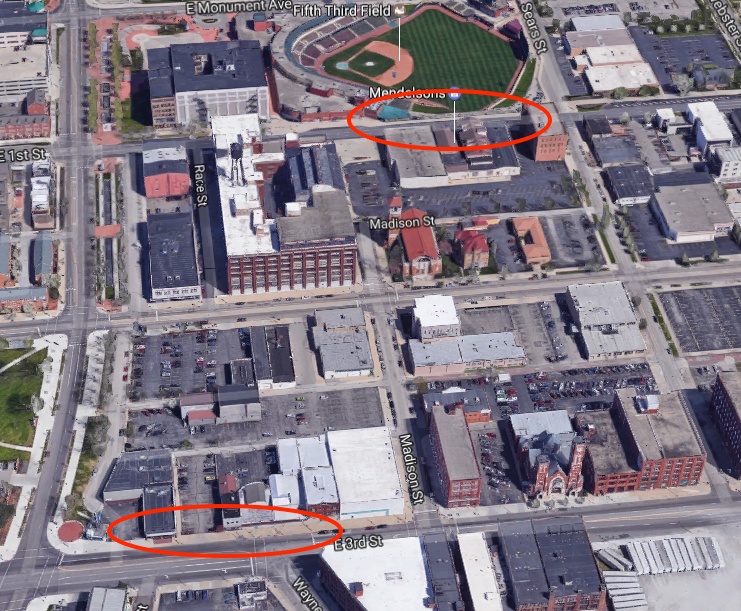
As a double-check, I decided to continue mapping some of the other folks referenced in and around the Blacker family in the census and it actually appears they lived in a different location at the time the census was taken in October of that year. If my calculations are correct, they lived on First Street between Madison and Sears – just a few blocks north of the Third Street location – at the time of the census.

I still believe the “Lewis Blacker” in the census record (October 1850) and the “Lewis Blicker” in the Dayton directory (published in August 1850) are likely the same individual, as it seems entirely plausible that the family might have lived in two different locations in the same year.

Shown below are the two different locations on the historical Dayton map . . .
And here are those same two locations shown on a current Google map . . .
Obviously, none of this information answers my ultimate brick wall question, which is . . .

Where in Germany were Lewis and Margaret born??

But while driving in my virtual car up and down Third Street, I noticed a church in the block just on the other side of Madison St. I zoomed in on the church sign and saw that the name was St. John’s United Church of Christ. I then located the church website and learned the following:

  • St. John’s was established by a group of German Evangelical Protestants in 1840 as the “German Evangelical Congregation”
  • The original meeting location was in the old courthouse located at 3rd Street and Main
  • The East 3rd Street site was built in 1865
  • That building was destroyed by fire in 1899 and construction on the new church was completed in 1901

So that’s some good information. The church was not in that location in 1850 when the Blacker family lived down the street, but it was in existence at another location. So that’s definitely worth further investigation for possible records.

And once again, you never know what you’ll find on Google!!

Copyright (c) 2017, Lark M. Dalin Robart

Featured Image attribution: By Google Inc. [Public domain], via Wikimedia Commons
 

My trip to RootsTech 2017: part 3

Click here to read parts 1 and 2 in this series . . .

Where in the world does time go? I’ve been busy researching my biggest “brick wall” and have totally neglected this blog series.

So now it’s time to finally “WRAP IT UP!”

FRIDAY February 10th

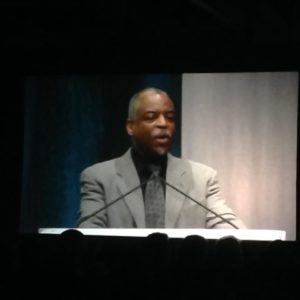
Friday was African Heritage Day and was kicked off by LeVar Burton’s inspirational keynote speech, truly one of the highlights of the week. I particularly enjoyed hearing him reminisce about his story-telling mentors, including his mother and a guy named “Fred” – he said we might know him as Mister Rogers.

My first session of the day was at 11 o’clock – “Using Autosomal DNA to Help Extend a Lineage” by Thomas Jones. This session was probably my favorite of the week. I had so many take-aways from this presentation but I’ll just share this one . . .

  • If you ever get a chance to hear Thomas Jones speak, GRAB IT!

The next session was “Instagram: 5 Reasons Genealogists Should Use It!” by Maureen Taylor, otherwise known as The Photo Detective. About a year ago, I had a phone consultation with Maureen about a few unidentified photos. You can read about that consultation here.

I was curious about this session – wondering if there might be any applications for genealogy bloggers. A couple ideas she shared along those lines . . .

  • Attracting people to a surname group
  • Sharing orphan photos and asking, “Who are the people in the photo?” or maybe looking for additional information about a photo, i.e., “Where are they standing?”

She also talked about watermarking photos, which I found to be helpful. Click here for a video she prepared on this topic.

At  3 o’clock, I attended another interesting session by Thomas Jones, “When Does Newfound Evidence Overturn a Proved Conclusion?”

Again, this session was a little over my head but I really wanted to hear him speak again. No matter the topic, I feel like I always learn something new from this guy.

I visited the Legacy Family Tree Webinars web page to see what presentations he has done there.1 And he has done three presentations, one of which is free. Click here for the link. And there’s more good news! On September 19th, 2017, he is doing the same presentation I watched at Rootstech – I might even watch it again! Here’s the link to sign up for free.

That evening, my husband and I attended the MyHeritage RootsTech After Party. Everyone had a great time!

Here’s a short video from that night. There’s a quick peek (and I do mean quick!) of me and my new friend Yvonne2 at the 11 second mark.

SATURDAY February 11th

I was unable to attend the General Session on Saturday morning, which was disappointing since I wanted to hear CeCe Moore. Luckily, her presentation was taped. Click here for the link.

The first session I attended that morning was “Irish Research – Using Online Resources”, taught by Rick Sayre, a genealogist who specializes in National Archives records, federal and state land records, military records, using maps in genealogy, urban research, and government documents.

I learned a few new things . . .

  • Castle Garden, America’s first official immigration center, has some immigrant records that are not on Ancestry.
  • The most comprehensive Griffith’s Valuation records are at FindMyPast, including the original maps.
  • FindMyPast also has Landed Estates Court Rentals (1850-1885).
  • There is also a database at FindMyPast for landed deeds (including deeds from the 1890s) – the records are scanned but not indexed.
  • The Public Record Office of Northern Ireland (PRONI) has some records related to the Republic of Ireland.
  • FindMyPast will probably end up scanning and indexing the Valuation Revision records for the Republic of Ireland.

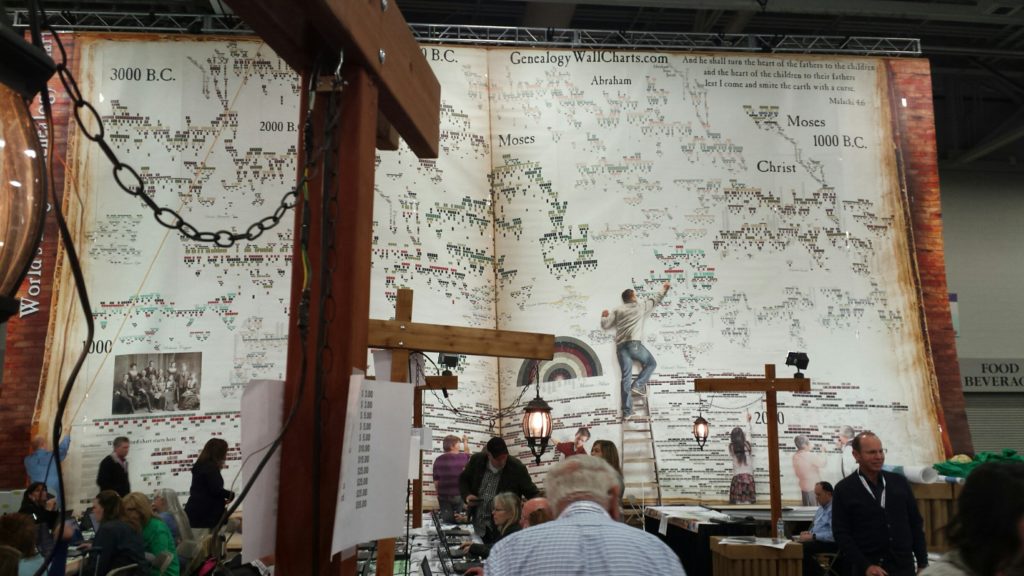
During the lunch break, I took some time to walk through the Expo Hall. Near the back of the hall, behind the Media Hub, was this amazing chart (30 ft x 100 ft) from Genealogy Wall Charts.

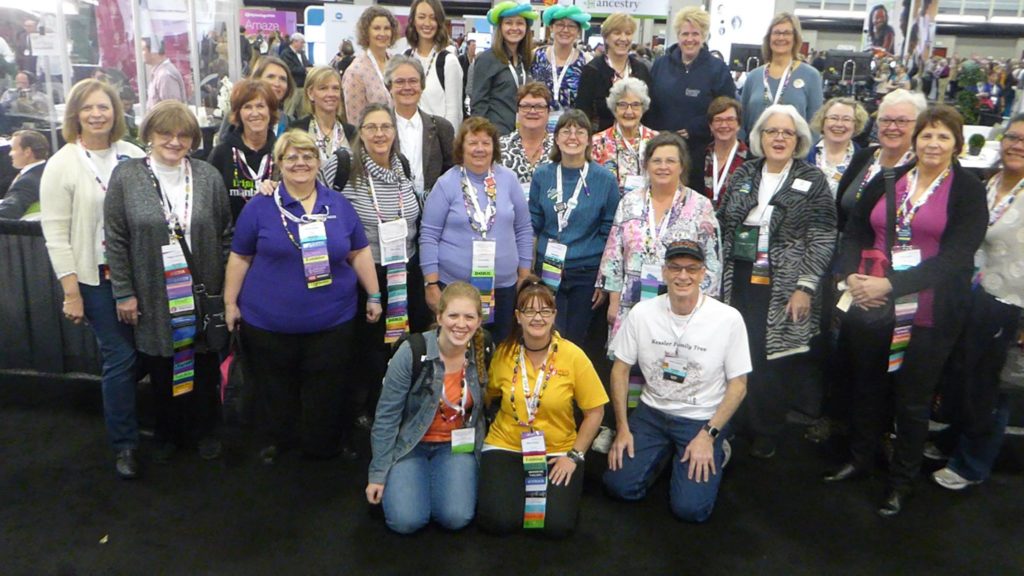
At 12:30, a group of Geneabloggers met in the Expo Hall so we could have a group picture taken. Here we are – I am third from the left.

I also made a point to visit the Southern California Genealogical Society (SCGS) booth. As much as I loved RootsTech, I’m interested in attending the SCGS conference known as Jamboree. Probably not this year – but I’m already savings my pennies for next year!

At 1:30, I attended my last RootsTech session, entitled “Sources and Structures for Successful Genealogical Research in Germany”, presented by Dirk Weissleder, a leading genealogist from Germany. My biggest brick wall on my mother’s side is her German line so this presentation was particularly interesting to me.

A few take-aways from this session . . .

  • Germany is divided into 16 states and each state has its own collection of records
  • Germany has no census records, at least not in the way we think of census records in the U.S.
  • Legal restrictions are very tight in Germany, making research even more difficult
  • DNA research is just beginning in Germany
  • There are no one-name study groups in Germany

I have to say I left this presentation feeling a bit discouraged. I hadn’t fully comprehended until then how difficult German research could be . . . especially when a certain researcher (yeah, that’s me) doesn’t have a clue where in Germany her ancestors came from.

And that reminds me . . . I forgot to mention the 20-minute free consultation session I had with a professional genealogist earlier that week. And I used that opportunity to discuss my German brick wall. So as I think about it, I’ve decided to write a separate blog post about that session. Stay tuned for that post, hopefully in the next few days.

So that’s it for my wrap-up of RootsTech 2017. The general sessions were great fun and the presentations were interesting and informative. I had a great time meeting genealogy enthusiasts from all over the world, and especially other family history bloggers.

Featured Image Photo Credit: “wrap it up, 3D rendering,” CanStockPhoto (http://www.canstockphoto.com : uploaded by argus 11 Jun 2016; downloaded 06 Mar 2017).

NOTES
  1. I HIGHLY recommend these webinars, by the way. The monthly subscription fee is just under $10 and the annual subscription is just under $50. Definitely a good deal for the quality and breadth of topics discussed!
  2. I met Yvonne, a genealogy blogger, and her husband earlier in the week.