This blog post is written in response to Amy Johnson Crow’s invitation to participate in the 2026 52 Ancestors in 52 Weeks Challenge. Prompt for Week 3: What This Story Means to Me
The Early Years
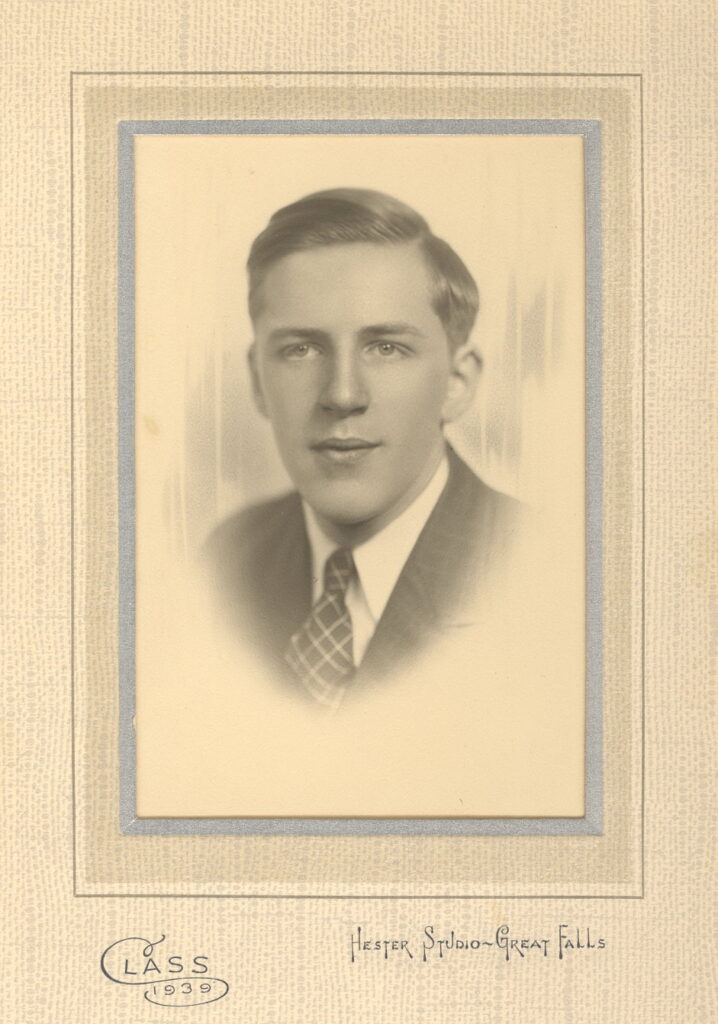
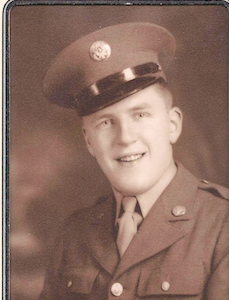
Melvin J. Schenck entered the world on September 11, 1921, in Neihart, a small mining town in Montana-a place shaped by hard work, deep winters, and close-knit families who depended on one another. His own family reflected an American story carried west by immigrants seeking opportunity. His father, born in Michigan in 1879, was the son of Swiss German parents who had crossed an ocean in pursuit of something better. His mother, born in Minnesota in 1887, descended from first-generation Scandinavian parents whose culture and quiet resilience shaped their household.
Melvin was the ninth of eleven children, though the family bore the sorrow of three sons lost before his birth. Even with that grief woven into their history, the Schenck home was full – full of voices, responsibilities, and the daily rhythm of life in a large family learning to make do. When Melvin was five, the family moved to Great Falls, a growing industrial city roughly an hour from Neihart. For eight years, he adjusted to new routines, new classrooms, and a different pace of life. But at thirteen, they returned to Neihart, back to the mountains where he had taken his first steps. That return, to familiar peaks in a smaller community, helped define his teenage years.
As a student, Melvin gravitated toward numbers. Mathematics was his favorite subject, a steady language that made sense to him. Outside the classroom, he read constantly – books offering a world beyond Montana, even though he himself had never traveled outside the state. Shakespeare fascinated him, and he read the plays not only because they were assigned but because he enjoyed them. The Comedy of Errors was his favorite, a story of confusion and misdirection that he found both clever and amusing.
When he reflected on his life as a senior in high school, he wrote plainly of his hopes. He wished to attend college, dreaming of becoming an engineer. It was a goal-shaped by talent and ambition, and an earnest desire to build something lasting. his path forward seemed clear, grounded and discipline, curiosity, and the momentum of a young man looking toward adulthood.
A few quotes from Melvin’s autobiography written during his senior year of high school . . .
“During my life, I have done little traveling; I was never out of the state of Montana. This summer, however, my brother and I spent one week with our brother, Donald, in Shelby and we were able to visit Cut Bank, Sweetgrass and other cities around that country.”
“When I finish high school, I certainly hope I’ll be able to go to college. If I can’t go immediately after I graduate I may get a chance later. As for my life work I would like to take up engineering or else become a mathematician.”
“My favorite amusement is reading … I especially like O. Henry’s short stories … and mystery novels …”
Enlistment and Training
Everything shifted after the attack on Pearl Harbor. Like many young Americans, Melvin answered the call to serve. On February 16, 1942, he enlisted in the U.S. Army. At the time, he was working for the Crane Company at the Great Falls railroad yards, a job tied to the city’s industrial heartbeat. Military service promised change, challenge, and a sense of purpose larger than his own plans.
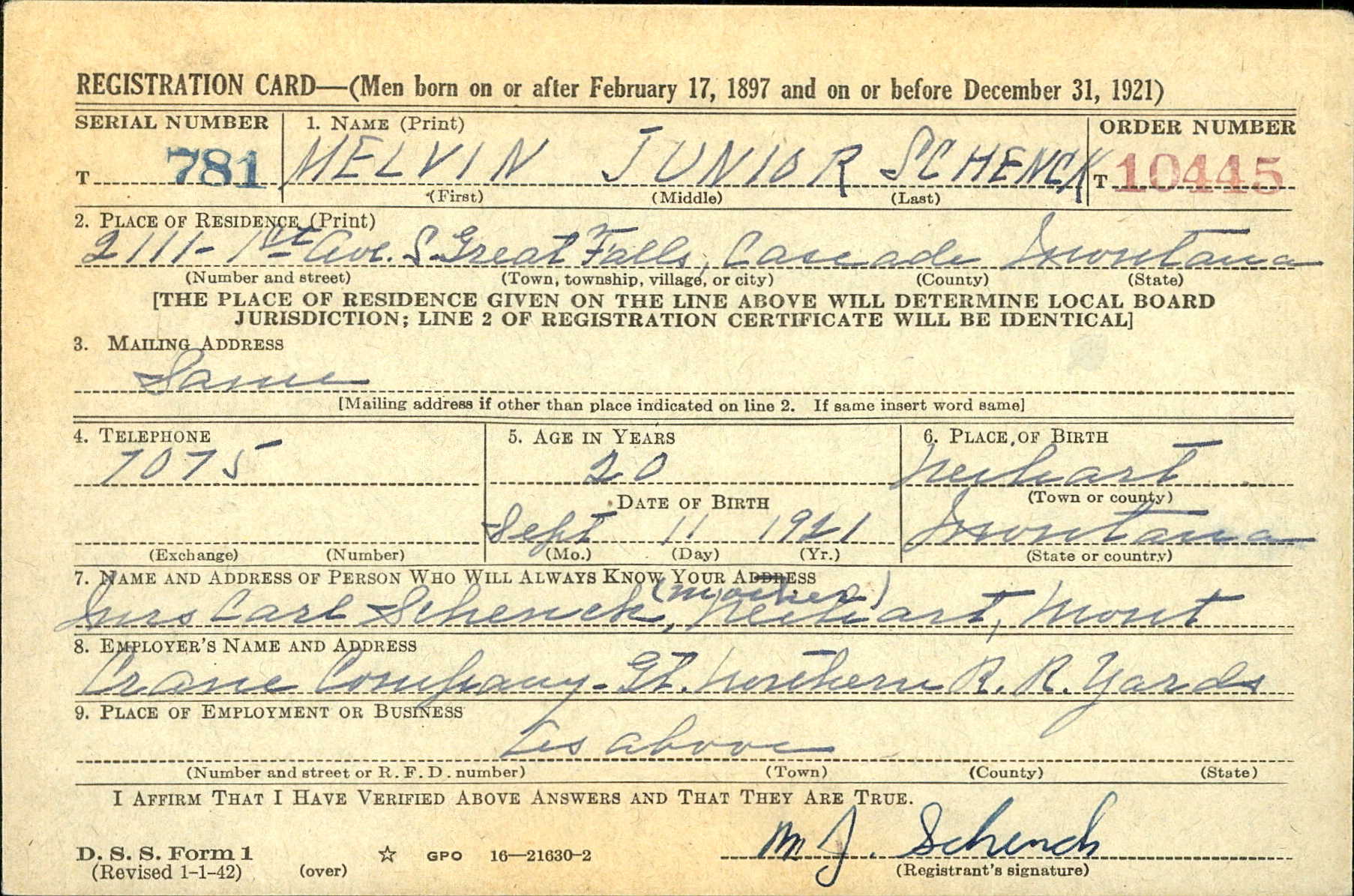
His physical description, recorded on the Registrar’s Report, captured a young man still standing at the threshold of life – 5 feet 10 inches tall, weighing 140 pounds, with a light complexion, blue eyes, and brown hair.
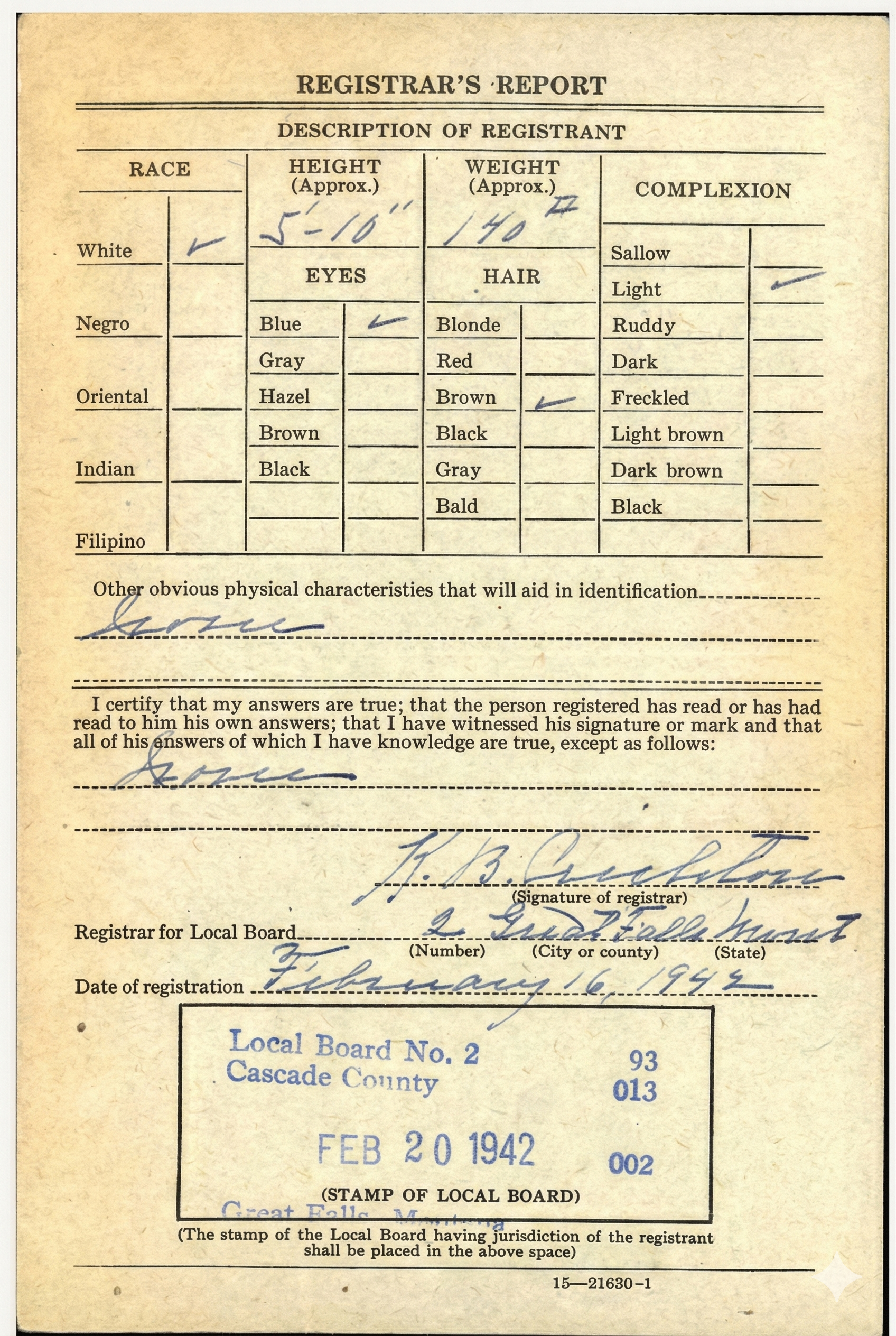
Training took him far from Montana, first to Camp Bartley and then Camp Maxey in Texas. The scale, speed, and intensity of army life transformed him. For one year he was an Army student at the University of Arkansas, furthering his studies and the uncertainties of wartime. Though his path toward engineering had been interrupted, his dedication to learning never faded.
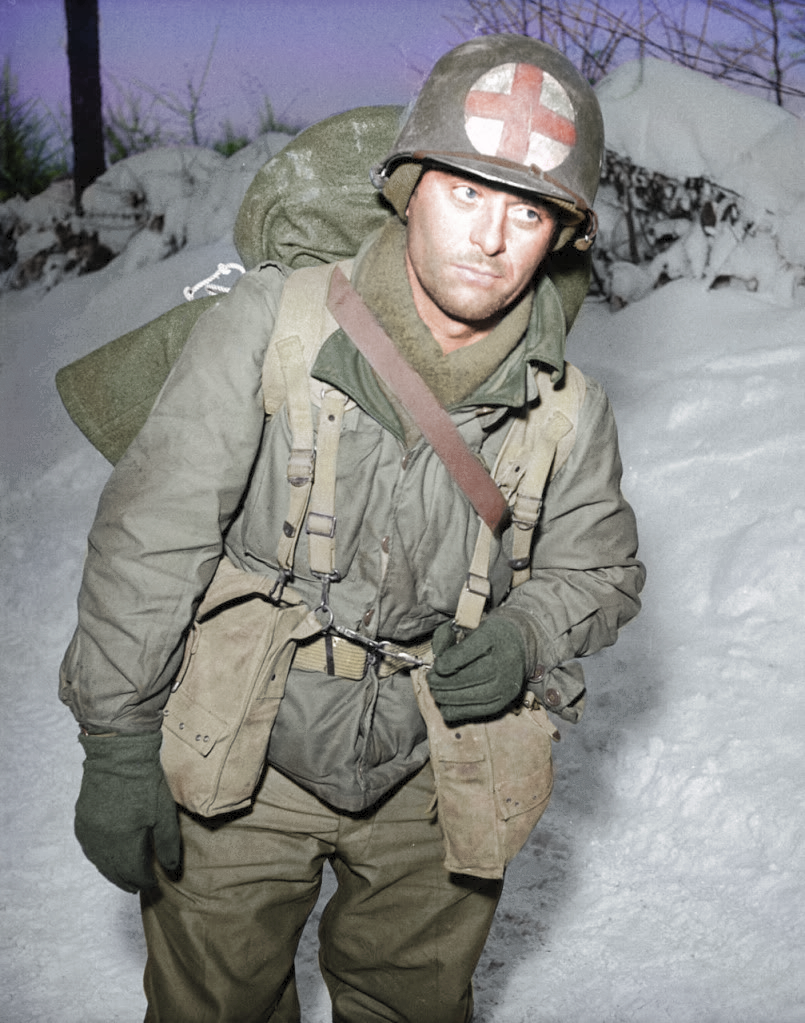
An exhausted American medic returning from the front during the Battle of the Bulge. Combat or field medics in World War II were military personnel prepared in a medical basic training, responsible for providing first aid and frontline trauma care on the battlefield. However, they could assist other units, even preparing patients for operations, making beds, or serving as cooks. Geneva Convention completely prohibits medics from using weapons. Medics could use a weapon to protect a casualty, but not themselves. Quoting Steven Ambrose, “It was the universal opinion of the front line infantry that the medics were the bravest of all.”
Photo source: Wikimedia Commons
In September 1944, Melvin deployed overseas as a member of the 394th Infantry Medical Detachment. By early November, he had reached France and soon after Belgium. His role placed him close to the front lines, where medics bore both responsibility and risk. Emergency treatment, casualty evacuation, establishing aid stations – these were the tasks he faced daily. Medics were often the difference between life and death, and they perform their duties under the most difficult conditions imaginable.
Service ran deep in the Schenck family. Three of his brothers also wore the uniform. Aaron served as a technician fifth class with the ski troops in Italy. Edgar became a captain with airborne forces in Holland and Germany. Donald, a yeoman first class with the Navy Seabees, served throughout the Pacific. Each son stepped into a different corner of the conflict, carrying the weight of duty in their own way.
Report By Major Stephen M. Gillespie
The final chapter of Melvin’s service unfolded during the battle of the bulge, when the German counteroffensive tore through the Ardennes in mid-December 1944. Major Steven M Gillespie’s report, a stark accounting of those days, describe the chaos that engulfed Melvin’s unit.
At 5:00 a.m. on December 16th, heavy artillery fire began pounding the village of Hunningen. The barrage continued relentlessly for two full days. On December 17th, at 2:00 p.m., the troops were ordered to withdraw to Murringen. The medical detachment moved with them, establishing aid stations in the basements of shell torn houses.
The shelling resumed that night, forcing personnel to shift patients into a cramped cellar. With no electricity, they relied on candles and flashlights to care for the wounded. For two nights they endured constant bombardment, sleeplessness, and a lack of food.
Shortly after 1:45 a.m. on December 18th, word arrived that the regiment must withdraw again, this time at 2:30 a.m. No ambulances were available. Medics unloaded a 2 1/2-ton truck of supplies so the wounded could be transported, while other personnel boarded a regimental CP truck. Officers traveled separately by jeep. Within moments, an order came to abandon all vehicles due to enemy action.
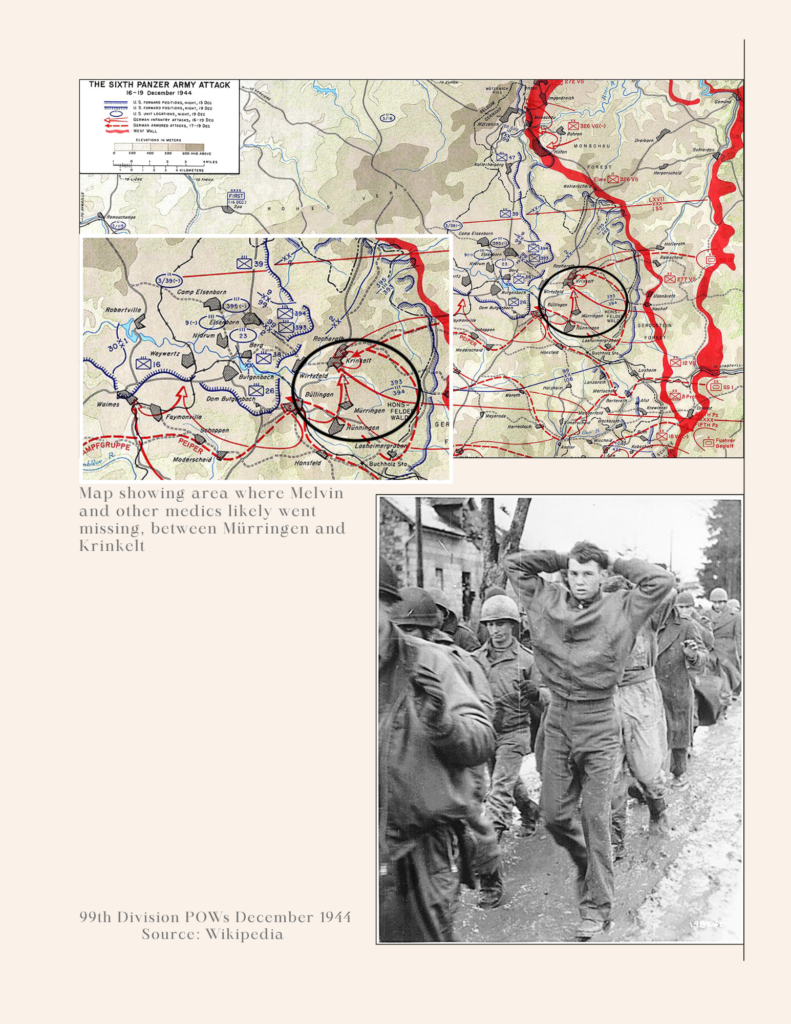
The troops continued on foot toward Krinkelt, with Camp Elsenborn as the ultimate destination. Once they reached Elsenborn, a devastating realization emerged: one-third of the detachment was missing. Melvin was among them. the regimental CP truck, carrying wounded soldiers and medical personnel, had not arrived.
Later reports revealed the truck had been ambushed outside Murringen. Five passengers were wounded. The remaining Battalion Aid stations and company aid men moved out again that afternoon to return to the front. This sector – Elsenborn Ridge – would become the only part of the American line where German forces failed to advance. Medics like Melvin played a critical role in that desperate stand.
Two dead American soldiers at a road intersection. Photo probably taken at Murringen on December 17, 1944. Source: Wikimedia Commons
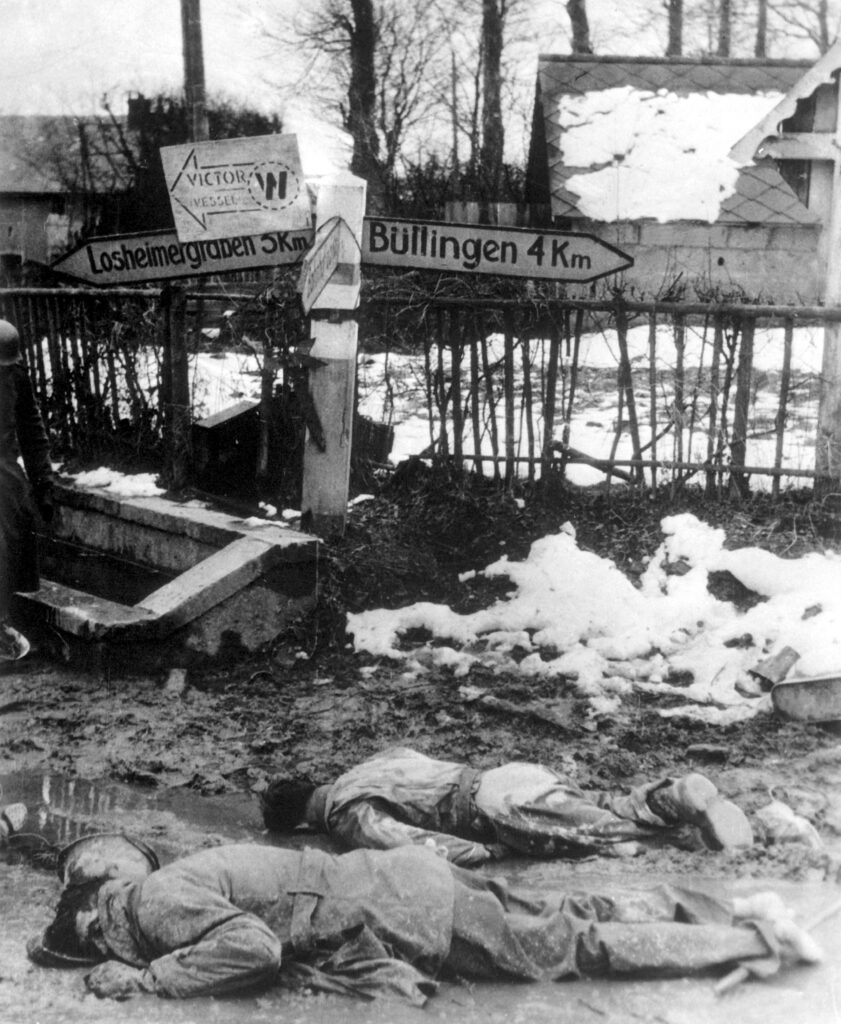
Later reports revealed the truck had been ambushed outside Murringen. Five passengers were wounded. The remaining Battalion Aid stations and company aid men moved out again that afternoon to return to the front. This sector – Elsenborn Ridge – would become the only part of the American line where German forces failed to advance. Medics like Melvin played a critical role in that desperate stand.
Newspaper Reports Back Home
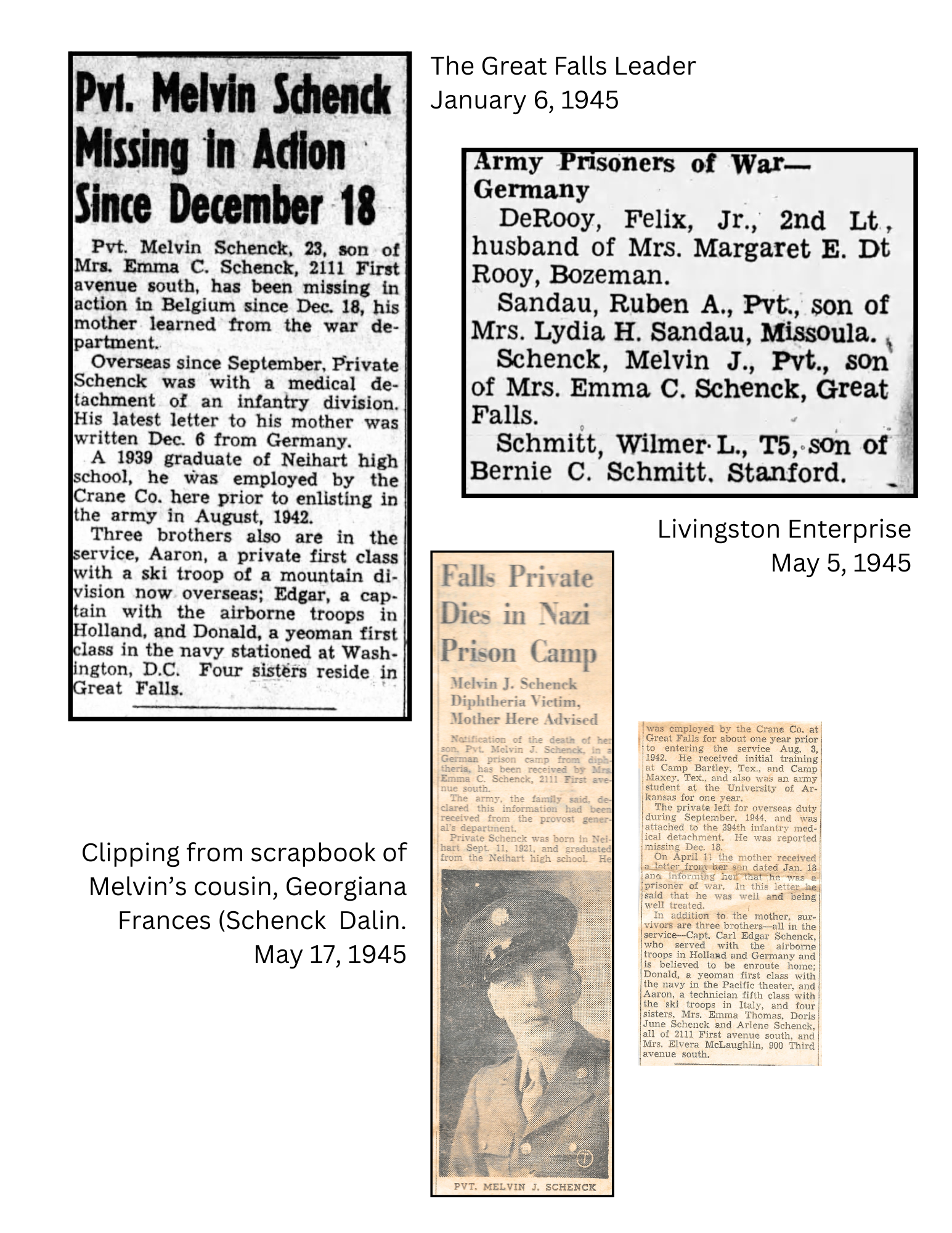
In Montana, the war reached Melvin’s family in fragments of newsprint. A Great Falls newspaper article dated January 6 reported him missing as of December 18, 1944. The announcement offered no details – only absence and uncertainty. His mother could do nothing but wait and pray.
For months she lived in that uncertainty, watching the war unfold in headlines while imagining her son somewhere in its vast machinery. On December 17, just one day before Melvin was reported missing, the Malmedy Massacre had taken place in Belgium – a brutal execution of 84 American prisoners of war. The event occurred near the area where Melvin had last been seen. For a mother already weighed down with fear, such news must have deepened her worry in ways words cannot fully express.
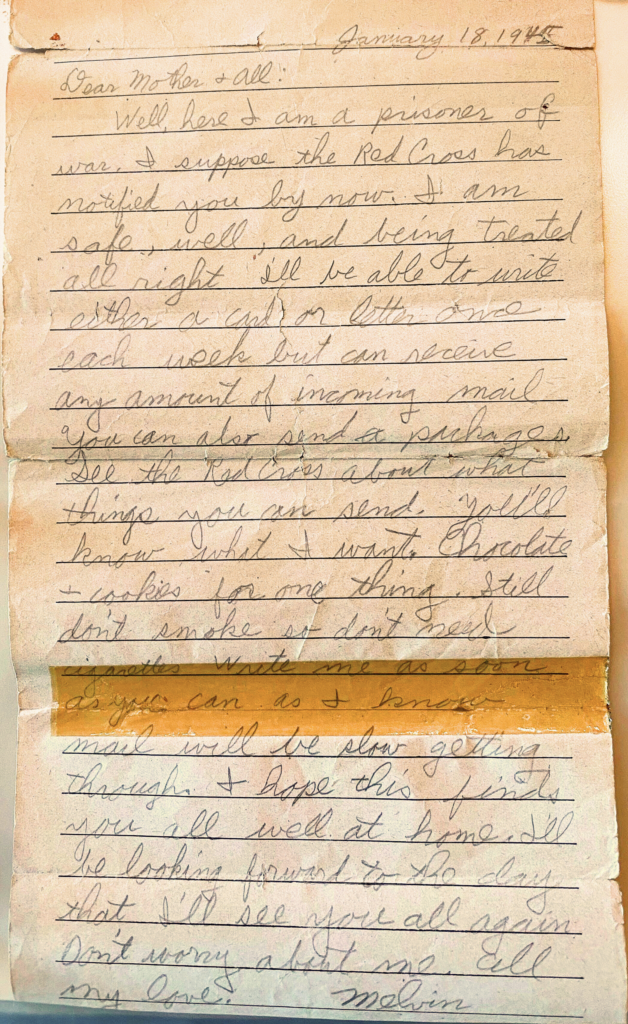
At last, on April 11, a letter arrived in her mailbox. It was from Melvin. He confirmed that he was a prisoner of war and wrote that he was “well and being well treated.” He asked if she might send chocolate and candy. But the letter was dated January 18. Nearly three months had passed between the moment he wrote those lines and the day she held them in her hands. Still, the message offered hope. He was alive.
Another month passed. The war was clearly nearing its end, and she must have prayed that liberation would come in time. When Germany unconditionally surrendered on May 7, she held on to hope for good news.
But on May 17, the Army notified her that her son had died of diphtheria on March 11, 1945, in a German prison camp. Only later did she realize that Melvin had already been gone for a month when she received his comforting letter in April.
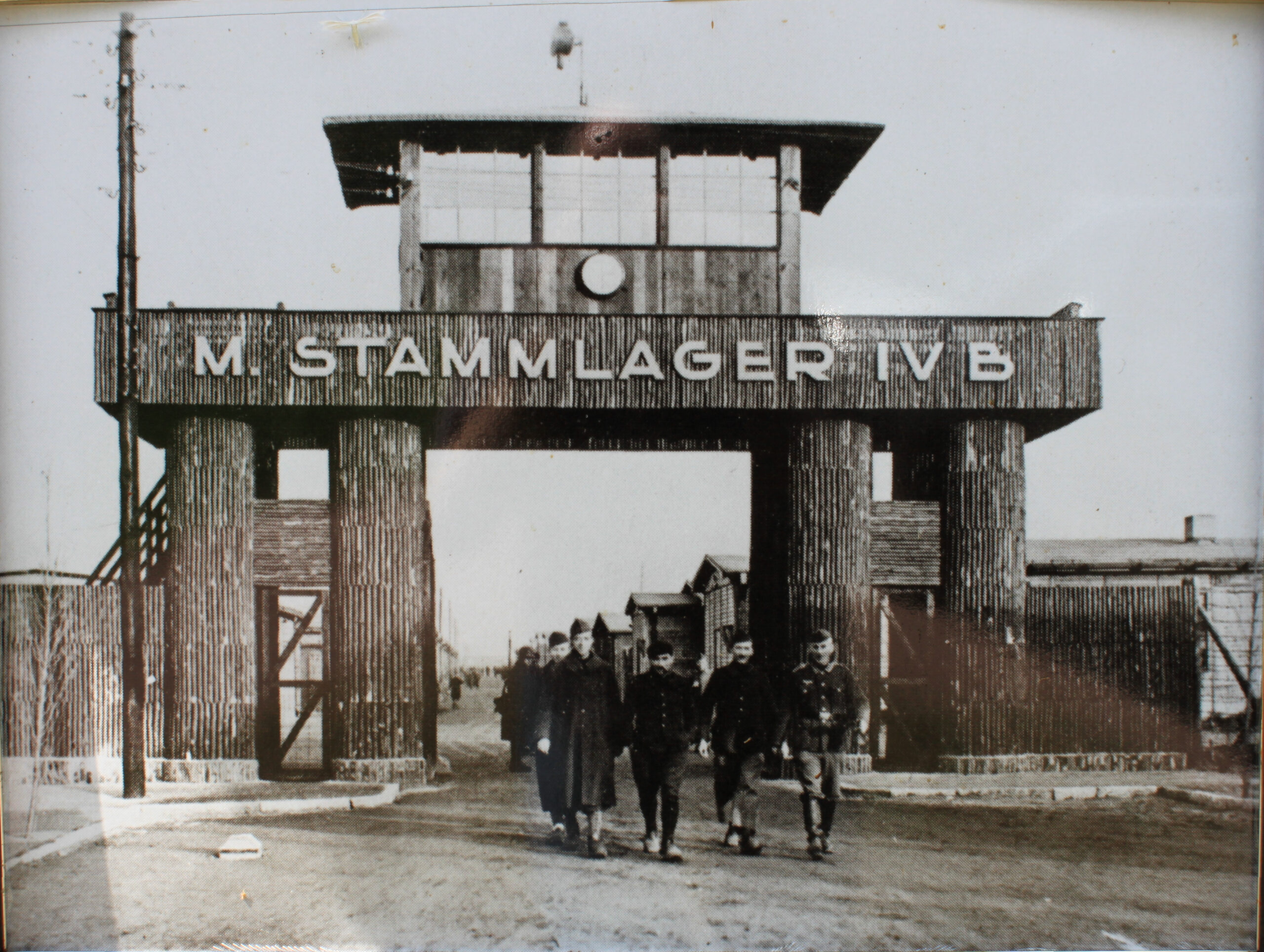
Stalag IV- Muhlberg
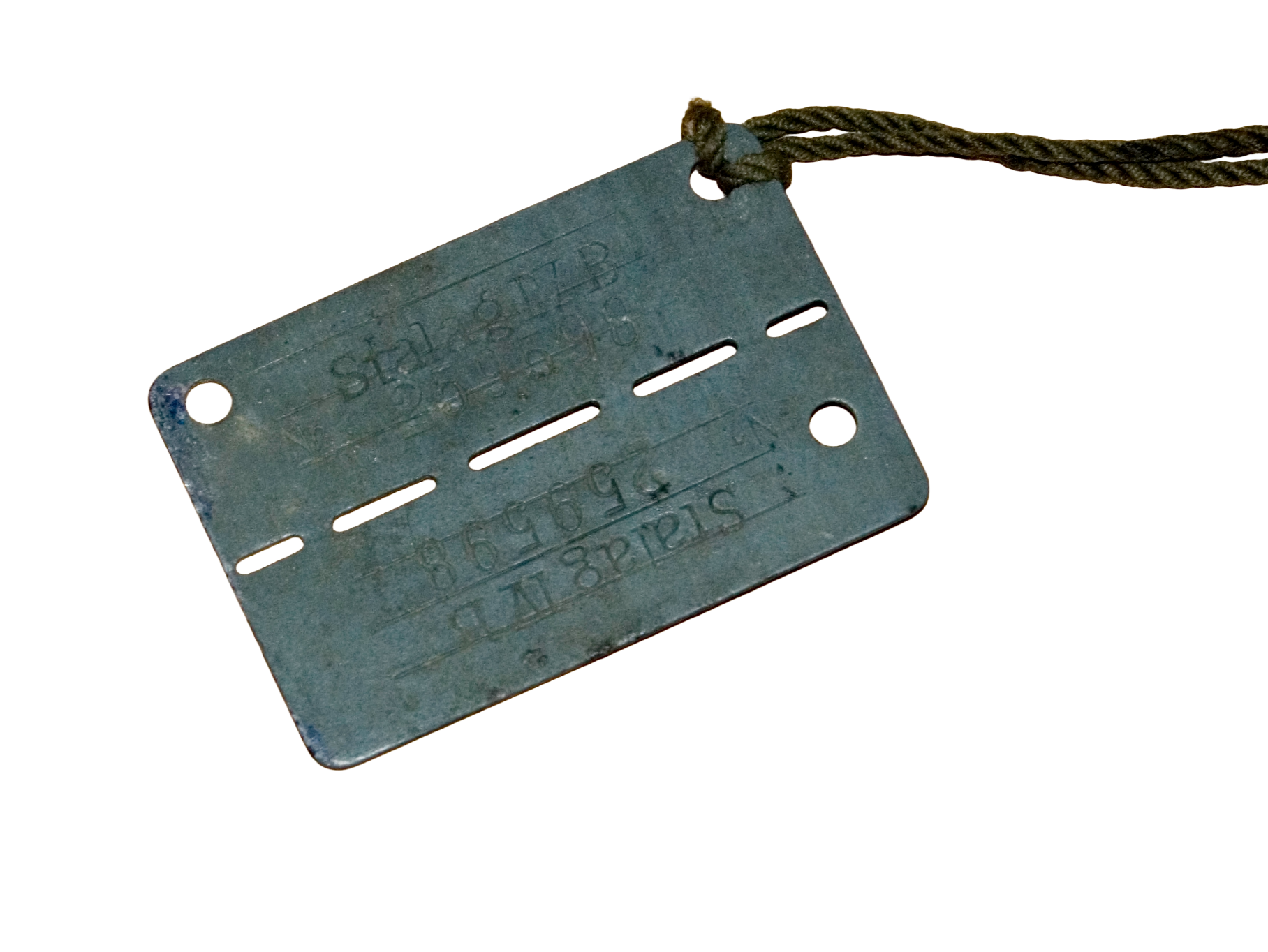
Melvin had been sent to Stalag IV-B Muhlberg, one of the largest prisoner-of-war camps in Germany. Designed to hold 15,000 men, it swelled to more than 30,000 during the final months of the war. After the Battle of the Bulge, 7,500 American soldiers were brought there, joining prisoners from thirty-three nations. Overcrowding led to shortages, disease, and harsh living conditions. Tuberculosis and typhus swept through the camp. By the time Soviet forces liberated it on April 23, 1945, approximately 3,000 soldiers had died within its barbed-wire boundaries.
Reproduction covered under German copyright law
Melvin was one of them. A young man who once dreamed of becoming an engineer, who loved mathematics and Shakespeare, who had never traveled outside Montana until the Army sent him across an ocean – his life ended far from the snowy mountains of his childhood.
Yet his story remains. It is carried in family memory, in official records, in the courage displayed during his final days of service, and in the quiet resolve of a young medic who gave his strength to save others. His life, though cut short, is honored in the history he helped shape.
Epilogue
On Saturday, July 28, 1945, Melvin’s mother, Mrs. Emma Schenck, was decorated as a Gold Star mother at the Veteran’s hall in Great Falls. She was among forty women to have been decorated that day, making her one of 109 Gold Star mothers in that vicinity.
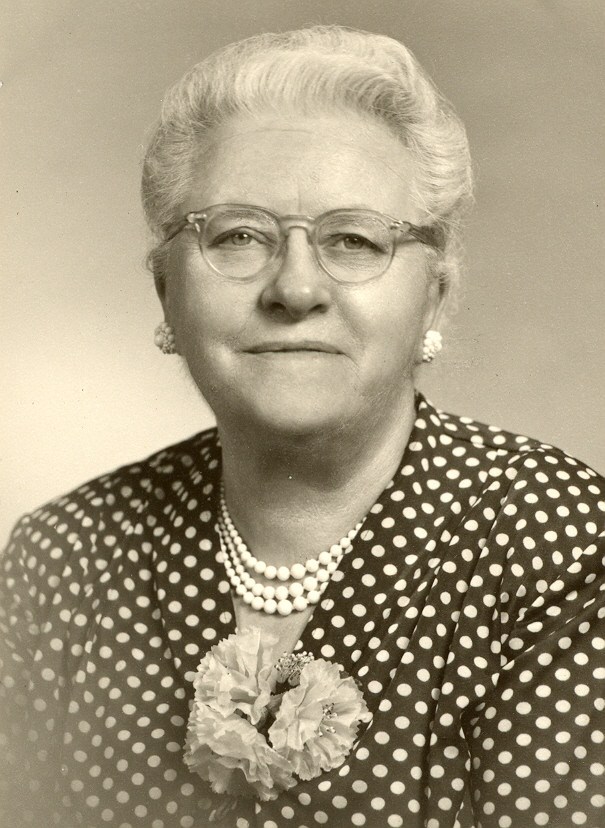
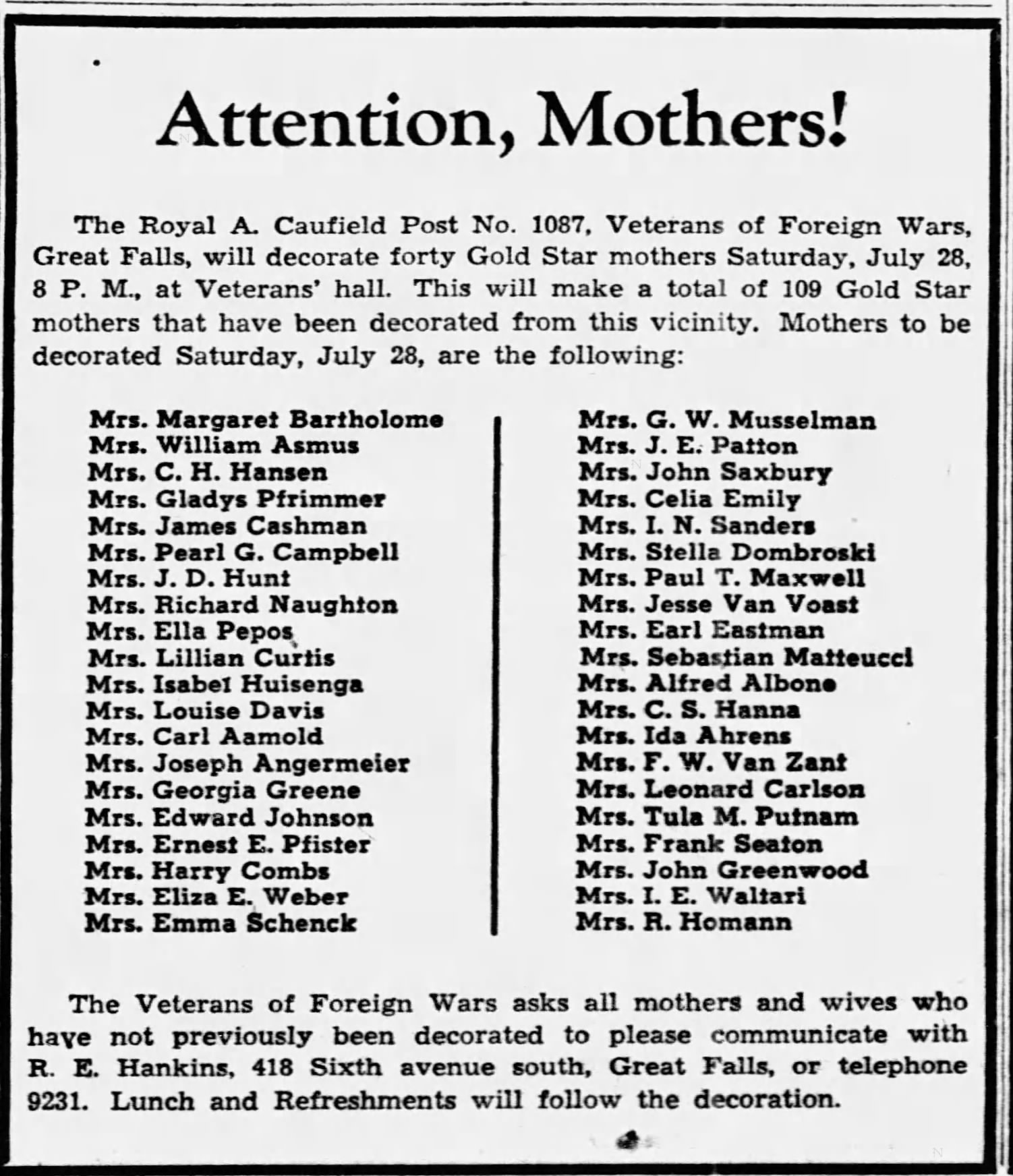
In 1949, she was seated as Sergeant at Arms for the same organization.
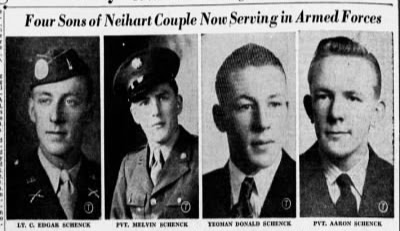
Captain Carl Edgar Schenck served with the airborne troops in Holland and Germany. Donald, Yeoman first class, served with the Navy in the Pacific Theater. Aaron served with the ski troops in Italy as a Technician fifth class.
All three returned home safely.
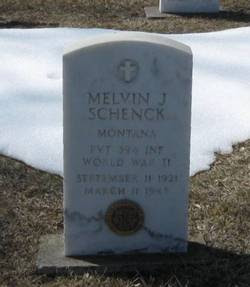
Melvin is buried in Highland Cemetery, Great Falls, Montana.
What This Story Means to Me
I did not grow up knowing the name Melvin J. Schenck. His story was not told at family gatherings, nor did I ever hear my father-who was Melvin’s cousin-speak his name. For many years, Melvin existed only as an absence, a branch on the family tree left unexplored.
I first discovered him by accident. While researching my paternal grandmother’s surname, SCHENCK, I stumbled across a military document listing missing personnel from World War II. There, among dozens of names, was a young man from Montana whose details felt uncannily familiar. At first I wasn’t sure if we were related, or whether he belonged to another Schenck line entirely. But the curiosity stayed with me.
Some time later, while looking through my grandmother’s scrapbook, I found a small newspaper clipping tucked between other family mementos. It reported a local soldier missing in action: Melvin J. Schenck. That fragile scrap of newsprint confirmed what I had begun to suspect. He was a member of our family.
The more I learned, the more I felt compelled to understand who he had been.
Several years ago, I met Melvin’s nephew Clayton and his wife Kathy, an experienced genealogist, who generously shared treasures that brought Melvin’s voice back across the decades: a copy of the letter he wrote to his mother from a prisoner-of-war camp, and an autobiography he penned as a high school senior. In those pages, I met a young man who loved mathematics, read Shakespeare for pleasure, and dreamed of becoming an engineer. His humanity-his personality-emerged with a clarity that both delighted and humbled me.
Writing this biography is my way of gathering the pieces of Melvin’s short life and placing them where they can be seen. His story is not only one of wartime sacrifice; it is the story of a boy from the Montana mountains, a son and brother, a medic who served with quiet courage, and a young man whose dreams stretched far beyond the world he knew.
By preserving his story, I hope to restore him to our family’s memory-and to ensure that future generations will know not just that he lived, but who he was.
It is an honor to tell his story.
Author Note #1: Much of the information in The Early Years chapter came from a three-page autobiography Melvin wrote during his senior year in high school. Much thanks goes to my cousins Clayton and Kathy for their friendship and for sharing the autobiography.
Author Note #2: Source for Major Gillespie’s report: National Archives and Records Administration, Record Group 407, Records of The Adjutant General’s Office, U.S. Army, World War II Unit Records, Records of the 99th Invantry Division, 394th Infantry Regiment, 14 Nov 44 – 25 Aug 44, Box 1419.
Author Note #3: Future generations should know that this piece was created during a time of technological transition. Artificial Intelligence was in the infant stages. AI assisted in editing of this story. Research, interpretation and storytelling reflect the author’s work, curiosity and dedication to preserving this story.